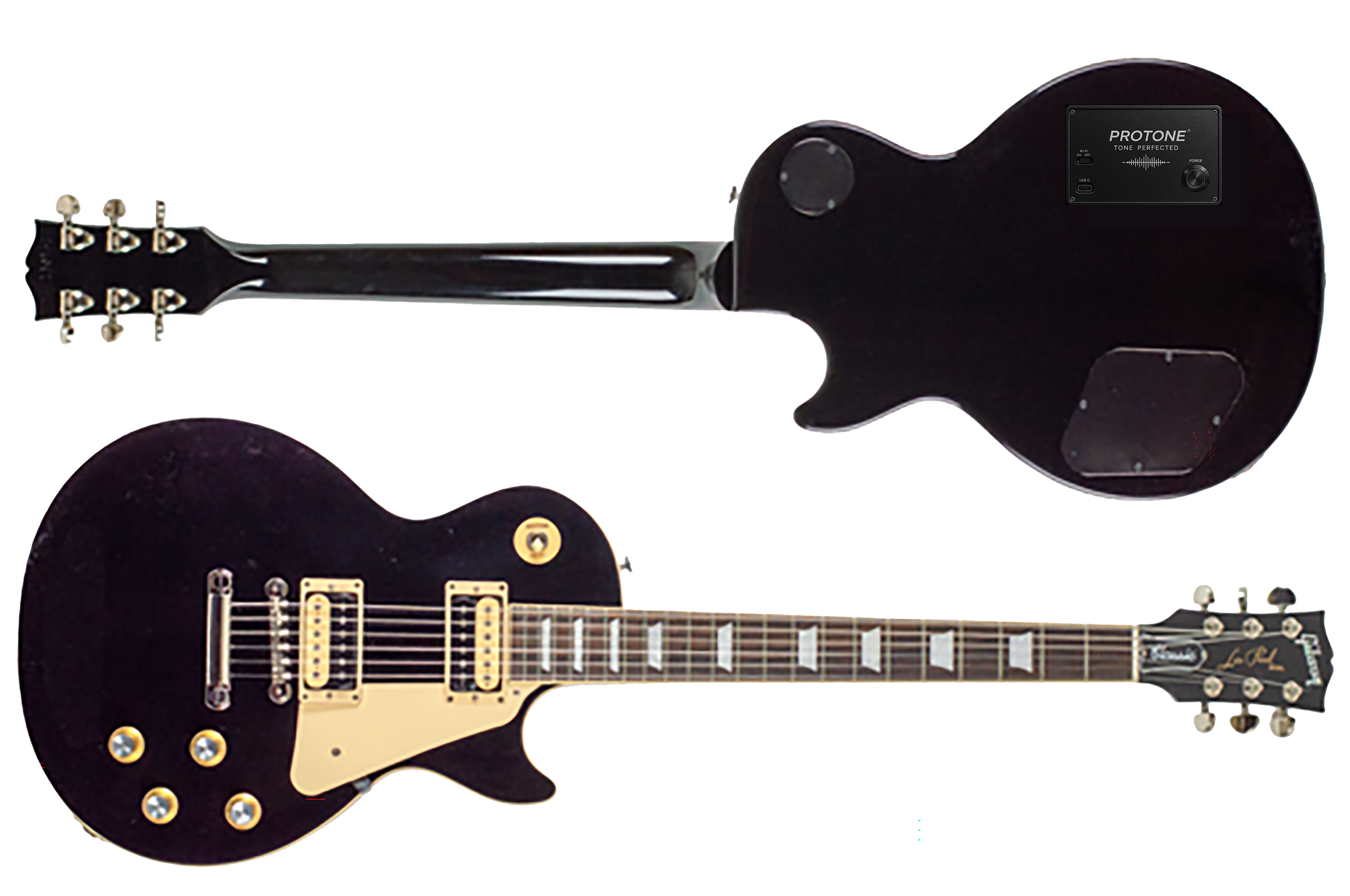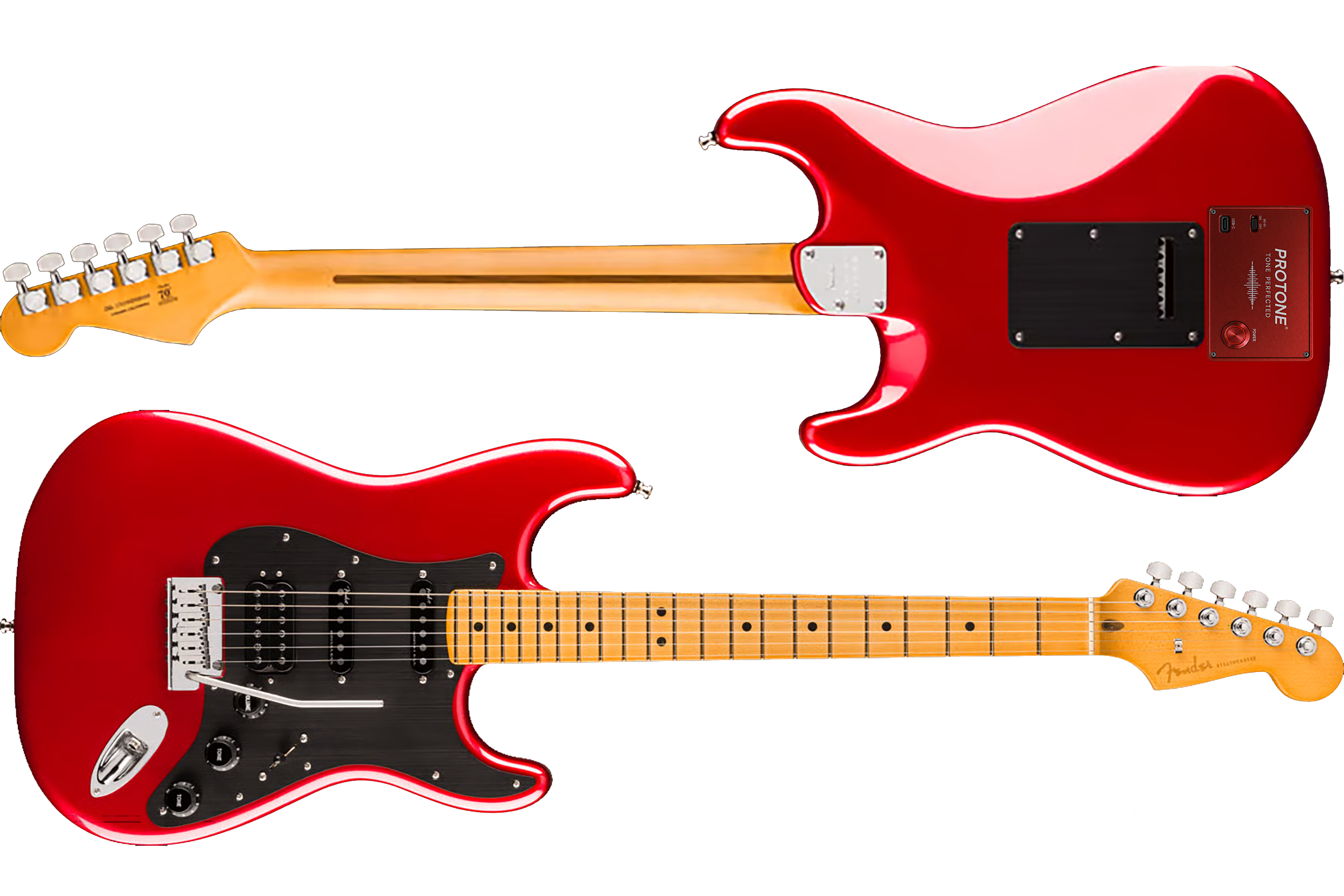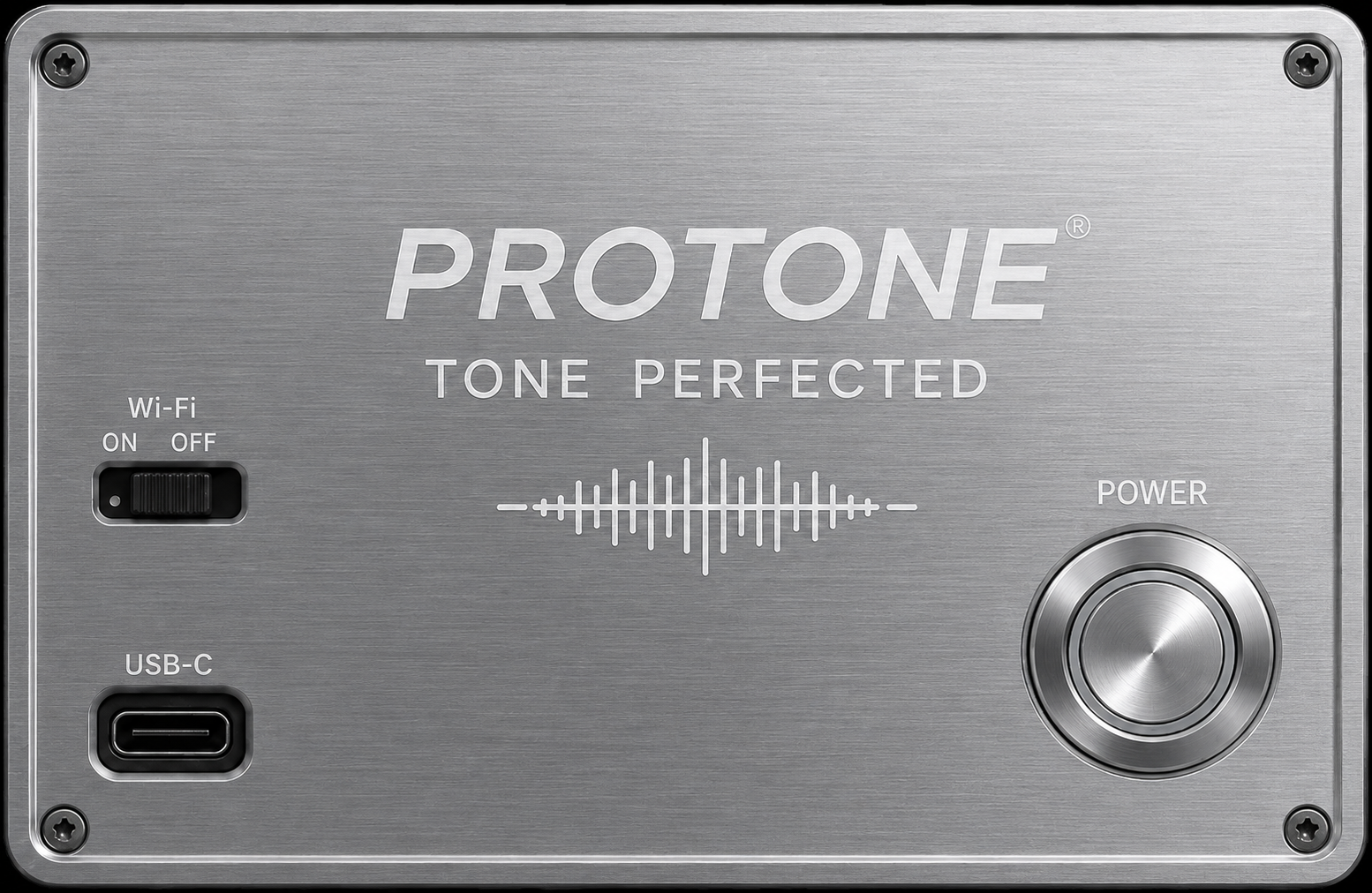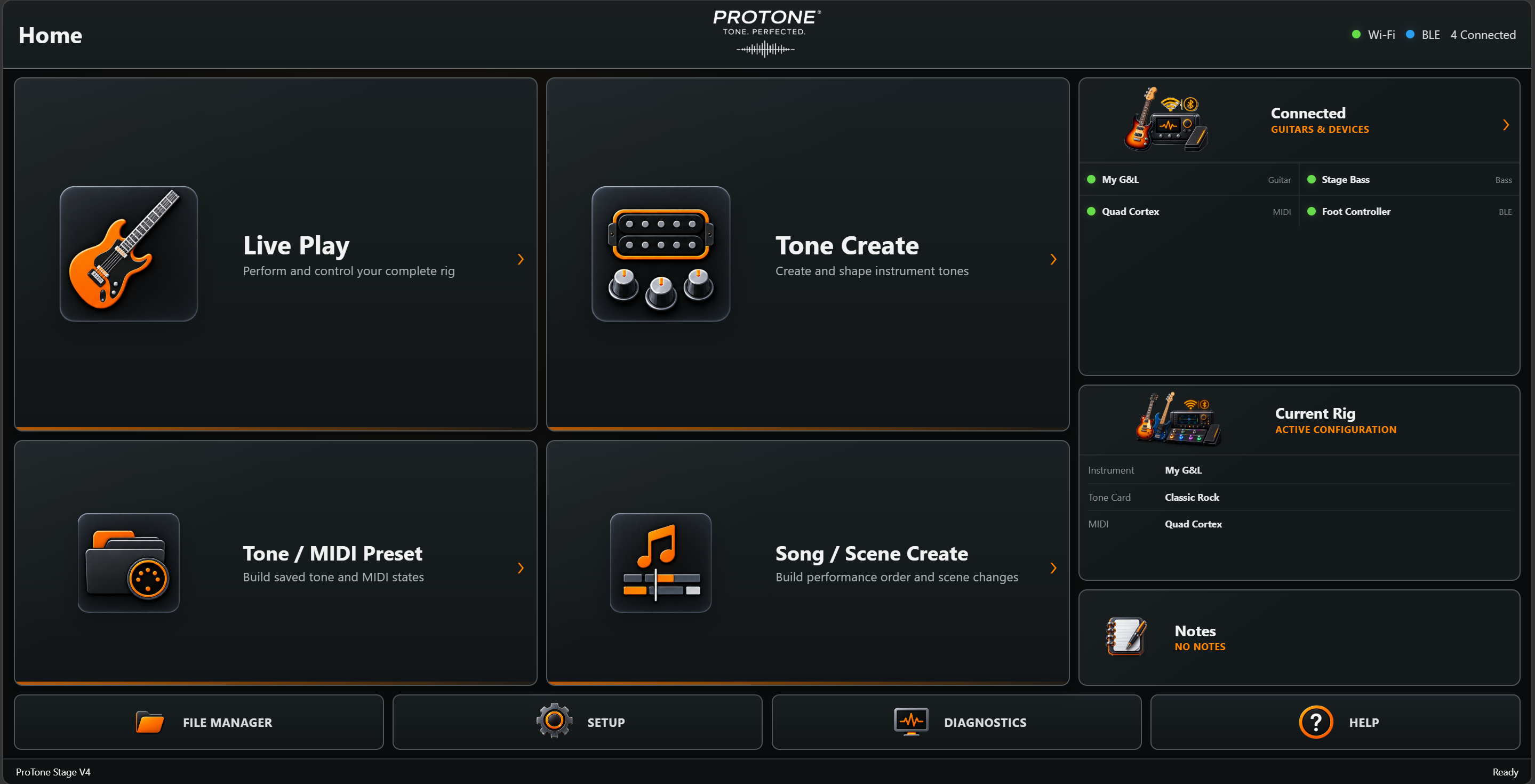
ProTone® V4 Stage
Tone Perfected
The Next Gen Tonal Platform
Bringing vintage pure‑analog voicing into the modern performance ecosystem.
The Next Gen Tonal Platform
Bringing vintage pure‑analog voicing into the modern performance ecosystem.
Analog pickups have always had more to say, but traditional guitar electronics could only access a fraction of their potential. Coil splits were on/off. Blending was limited. Phase was typically a fixed reversal. More advanced configurations often required additional switches, specialized wiring, or manual control, with little ability to store and recall the complete instrument setup.
Stage V4 makes the guitar’s or bass’s analog electronics programmable. Pickup and coil configurations, series and parallel relationships, phase relationships, continuously adjustable coil blending, pickup blending, tone shaping, programmable loading, gain, output level, and other supported analog functions can become part of a stored and repeatable instrument configuration.
The actual pickup audio signal remains in the analog path. Digital control configures the instrument’s electronics rather than replacing the pickups with a modeled representation.
The platform adds interchangeable Expansion Tone Cards, individually addressed guitars and basses, bidirectional MIDI, Presets, Scenes and Songs, coordinated multi-device control, browser-based configuration, cloud backup and sharing, and AI Assist.
Your guitar or bass becomes part of the Preset. Part of the Scene. Part of the Song. Part of the show.
ProTone doesn’t replace your gear. It integrates it.
Building on Proven Ideas
The music-technology industry has already validated demand for individual elements of this direction. Advanced pickup switching, expanded pickup voicing, programmable analog control, MIDI-enabled instruments, preset recall, digital rig integration, and other related capabilities have appeared in different products and systems.
Stage V4 brings a broader combination of programmable instrument control, expansion, recall, bidirectional MIDI, multi-instrument addressing, context-aware cloud services, AI assistance, and broader system integration together within one expandable guitar and bass platform.
At the center of every ProTone-equipped instrument is the Guitar Core, an embedded control platform that manages the instrument’s configuration, calibration, stored settings, system identity, communications, and supported ProTone functions.
The instrument’s actual pickup signal remains in the analog audio path. Digital control is used to configure the supported analog electronics surrounding the pickups rather than replacing the instrument with a modeled representation.
Because the Guitar Core resides inside each guitar or bass, the intelligence of the system travels with the instrument. A dedicated external ProTone controller is not required.
Compatible computers, tablets, phones, modelers, MIDI systems, show-control platforms, and optional ProTone interfaces can communicate with the instrument while the Guitar Core maintains its own identity and operating configuration.
Stage V4 provides bidirectional MIDI communication, allowing compatible equipment to control the ProTone instrument while also allowing the instrument to initiate commands for other supported MIDI devices.
This allows ProTone to participate directly in the preset and control environments already used by modelers, processors, DAWs, MIDI systems, and live-production equipment.
Each ProTone-equipped instrument can maintain its own system identity and address.
Multiple guitars and basses can therefore operate within the same environment while remaining independently controllable.
A system could include a lead guitar, rhythm guitar, bass, additional ProTone instruments, modelers, synthesizers, effects, vocal processors, and other compatible equipment, with supported commands directed only to the devices required for that particular performance change.
Stage V4 provides structured recall at the instrument level.
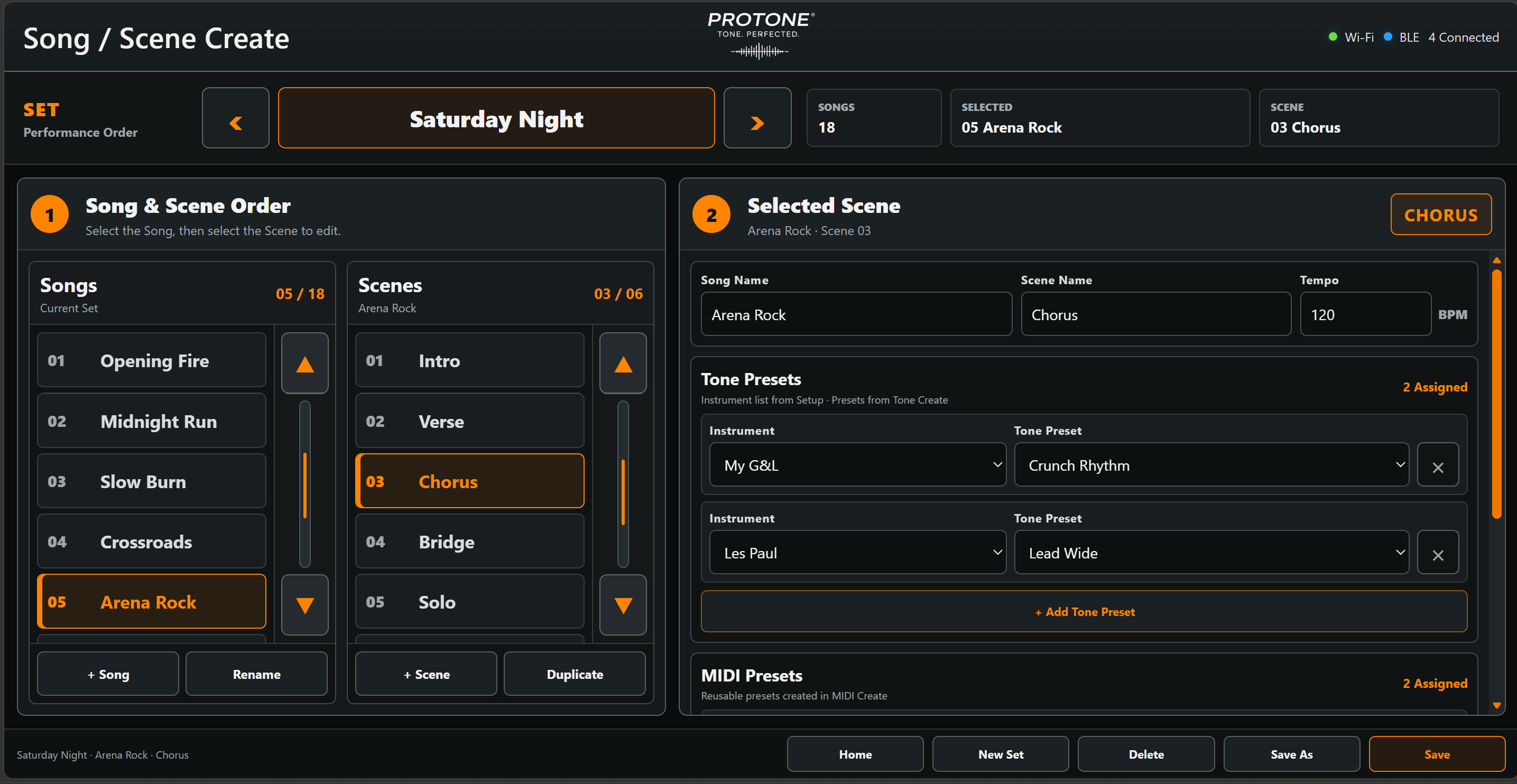
Presets store repeatable instrument configurations.
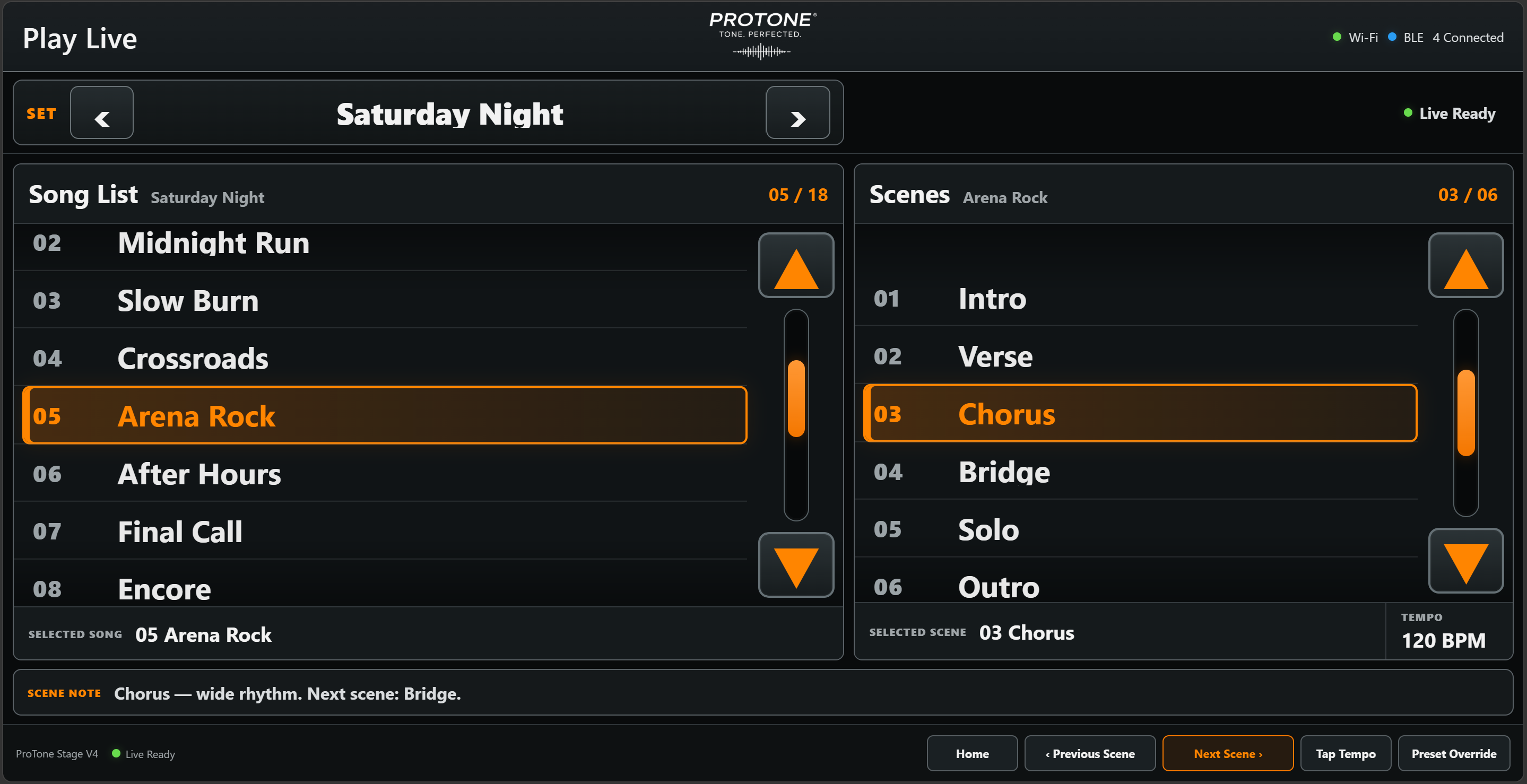
Scenes coordinate supported changes within ProTone and across compatible external equipment.
Songs organize those Scenes into a structured performance sequence.
A single action can therefore initiate coordinated changes throughout a supported rig instead of requiring the player to manually reconfigure each instrument and device independently.
ProTone makes the guitar or bass part of the programmable system rather than leaving it outside of it.
The ProTone® Stage V4 Expansion Tone Card system allows the platform to evolve without replacing the Guitar Core.
Interchangeable Expansion Tone Cards can add specialized analog tone circuits, additional tonal functions, selected effects capabilities, and other supported features to a ProTone-equipped instrument.
This creates a flexible architecture in which the core system remains consistent while additional capabilities can be developed for different products, artists, pickup systems, applications, and markets.
Specialized cards can be developed around particular musical genres, playing styles, or tonal objectives.
Authorized artist collaborations can combine specialized tonal concepts, configurations, and supported functions into artist or signature products.
Pickup manufacturers can develop cards designed around the characteristics and capabilities of particular pickup systems.
Instrument manufacturers and other partners can create specialized Expansion Tone Cards for individual instruments, product families, market segments, or custom applications.
Expansion Cards can incorporate additional analog tone shaping, filtering, loading, and other supported tonal functions.
Selected effects and additional analog processing capabilities can be incorporated into specialized Expansion Cards where appropriate.
For the musician, Expansion Tone Cards allow the instrument to gain new tonal capabilities without replacing the Guitar Core.
For the musician, Expansion Tone Cards allow the instrument to gain new tonal capabilities without replacing the Guitar Core.
For partners, the opportunity is considerably broader.
A common Stage V4 architecture can support an evolving family of:
● partner-developed products;
● artist collaborations;
● signature products;
● pickup-specific applications;
● genre-focused cards;
● custom OEM solutions;
● effects-oriented cards; and
● future ProTone capabilities.
The Expansion Tone Card is not simply an accessory. It creates an ongoing product and development platform around ProTone Stage V4.
ProTone Cloud extends Stage V4 through backup, controlled sharing, collaboration, and instrument-aware configuration data.
Cloud services are optional. A ProTone-equipped guitar or bass does not require a cloud connection for normal standalone operation.
ProTone Cloud can maintain supported:
● Presets;
● Scenes;
● Songs;
● ProTone configuration information; and
● associated system data.
This provides a recoverable library separate from the configurations stored locally within the instrument.
Traditional preset sharing often describes the settings of a modeler or processor while leaving out one of the most important variables in the signal chain:
The instrument feeding it.
A processor preset created with one guitar and pickup system can produce a substantially different result when used with another instrument.
ProTone Cloud is designed to preserve relevant instrument and system context alongside supported shared configurations.
That context can include information such as:
● guitar or bass configuration;
● pickup manufacturer and model;
● pickup architecture;
● relevant ProTone configuration;
● instrument calibration information;
● installed Expansion Tone Card;
● associated Preset, Scene, or Song; and
● compatible modeler, processor, MIDI, or other supported rig information.
● other relevant system information.
A shared configuration can therefore communicate not only:
but also:
The objective is not to claim that different instruments will produce identical results.
It is to provide the context required to make shared configurations more useful, understandable, and adaptable.
Each supported Preset can include a Private designation.
A Preset marked Private remains outside broader community sharing and AI Assist contribution according to the applicable service terms.
This allows users, artists, partners, producers, and other creators to protect configurations they do not want incorporated into the broader ProTone ecosystem.
Private content does not have to be limited to a single user.
A ProTone user can invite selected people into an authorized private area, including:
● band members;
● producers;
● engineers;
● guitar or bass technicians;
● collaborators;
● artists;
● product-development partners; or
● other approved participants.
A band could maintain a private library containing its Presets, Scenes, Songs, instrument configurations, and associated rig information while limiting access to authorized members.
A partner could use the same approach for development, artist evaluation, testing, or other collaborative applications.
Private collaboration and community sharing remain separate choices.
ProTone Cloud can also support:
● manufacturer configuration libraries;
● pickup-specific collections;
● artist-authorized content;
● genre collections;
● Expansion Tone Card libraries;
● modeler integrations;
● educational configurations; and
● curated ProTone system setups.
For partners, this creates a content environment linked not simply to a processor preset, but to the relationship between the instrument, pickups, ProTone configuration, Expansion Tone Card, and complete rig.
ProTone AI Assist is designed to help musicians navigate the capabilities of Stage V4 while preserving the deterministic control of the underlying ProTone system.
Participation in AI Assist begins with a completed ProTone instrument setup containing relevant information about the guitar or bass and its installed pickup system, including pickup manufacturer and model.
This gives AI Assist important context about the instrument it is assisting rather than treating every guitar, bass, pickup, and rig as though they were interchangeable.
AI Assist can work with the known capabilities of the supported ProTone environment, including relevant
information about:
● the guitar or bass;
● pickup manufacturer and model;
● pickup architecture;
● instrument calibration;
● available ProTone functions;
● installed Expansion Tone Card; and
● compatible external MIDI equipment.
A musician can describe a tonal or musical objective in familiar language rather than beginning with every individual technical parameter.
AI Assist can then propose compatible starting-point instrument and supported rig configurations that can be auditioned, compared, refined, and saved through the normal ProTone workflow.
AI Assist can also help users understand available ProTone functions, configuration choices, and supported system relationships.
The objective is to make an increasingly capable platform easier to use without forcing the interface itself to become increasingly complicated.
AI Assist does not directly replace the normal ProTone control system.
AI Assist proposes and explains.
ProTone validates and applies supported configurations.
This separation allows AI assistance to simplify tone creation and system configuration while maintaining predictable control of the underlying hardware.
A Growing Cloud Knowledge Base
The ProTone Cloud provides the database environment supporting AI Assist.
Users participating in Cloud + AI Assist agree to the applicable service and data-use terms.
Eligible configurations that are not designated Private can contribute to the growing AI Assist knowledge base.
Because the system can retain relevant instrument and rig context, AI Assist can learn from relationships such as:
Instrument → Pickups → ProTone Configuration → Expansion Tone Card → External Rig → Musical
Objective
rather than learning from isolated parameter values without knowing what equipment produced them.
As participation grows, this can create a progressively richer understanding of how different instruments, pickups, ProTone configurations, Expansion Tone Cards, and compatible external systems work together.
Respecting Artist & Signature Content
Community-created configurations and AI Assist data are not automatically presented as official artist or signature tones.
ProTone distinguishes between:
community-created content and AI-assisted tonal
guidance
and
authorized artist, signature, manufacturer, or partner content.
Official artist and signature products can be identified as such when developed through an appropriate authorized relationship.
This allows the AI Assist knowledge base to grow while maintaining a clear distinction between general tonal guidance and officially authorized artist or partner content.
Partner Opportunities With AI Assist
For partners, AI Assist creates an additional layer above the Stage V4 hardware platform.
As compatible instruments, pickups, Expansion Tone Cards, modelers, processors, and other products become part of the ProTone environment, AI Assist can help users discover and understand those capabilities.
This creates opportunities for manufacturer-developed configurations, pickup-specific recommendations, Expansion Tone Card content, modeler integrations, artist-authorized products, and other guided experiences within a common platform.
AI Assist is designed to make advanced capabilities more accessible without making the underlying instrument less authentic or less controllable.
ProTone® Stage V4 is designed as a configurable partner platform rather than a single fixed product.
Partner implementations can be adapted to different instruments, pickup systems, external equipment, product strategies, and markets while maintaining the underlying Stage V4 architecture.
Guitar & Bass Integration
ProTone can be adapted to supported guitars and basses with different:
● body and cavity requirements;
● pickup architectures;
● instrument layouts;
● control strategies;
● product configurations; and
● manufacturer requirements.
The physical implementation can be adapted to the instrument while preserving the common electrical and software platform.
This allows manufacturers to incorporate ProTone into existing or future instrument families rather than designing the instrument around one fixed ProTone form factor.
Pickup-System Configuration
Different pickup architectures can support different ProTone capabilities.
Stage V4 does not require every guitar or bass to use the same pickup topology or expose an identical configuration set.
The ProTone implementation can therefore be developed around the pickup system and product objectives selected by the partner.
Modeling Amplifier & Processor Integration
ProTone can integrate with compatible:
● modeling amplifiers;
● processors;
● effects systems;
● DAWs;
● MIDI systems; and
● show-control platforms.
Partner-specific MIDI mapping, configuration, validation, and supported workflow integration can be developed for individual platforms.
This allows a partner’s existing preset and Scene environment to incorporate the instrument itself rather than treating the guitar or bass as an unrelated signal source.
Expansion Tone Card Development
Partners can develop specialized Expansion Tone Cards around their own:
● pickup technologies;
● instrument models;
● tonal concepts;
● artists;
● effects;
● product families; or
● market applications.
The common Guitar Core allows these additional products to build upon the Stage V4 platform rather than requiring a completely new electronics system for each application.
Cloud & Content Customization
Partner-specific ProTone content can include:
● configuration libraries;
● pickup-specific collections;
● modeler integrations;
● Expansion Tone Card content;
● genre-focused collections;
● artist-authorized Presets;
● Scenes and Songs; and
● other supported cloud-based resources.
Relevant instrument and system context can remain associated with this content, providing users with more meaningful information about the products and configurations involved.
AI Assist Integration
Supported partner products and configurations can become part of the ProTone AI Assist environment.
This creates opportunities for AI Assist to guide users toward appropriate settings, configurations, Expansion Tone Cards, or compatible partner equipment based on the instrument and system actually available.
Partner-developed and artist-authorized content can remain clearly identified within the broader ProTone environment.
Artist & Signature Programs
Authorized artist programs can combine supported:
● instrument configurations;
● Expansion Tone Cards;
● Presets;
● Scenes;
● Songs;
● cloud content;
● AI Assist content; and
● partner products.
These programs can be developed around the artist while remaining part of the broader Stage V4 architecture rather than becoming isolated one-off systems.
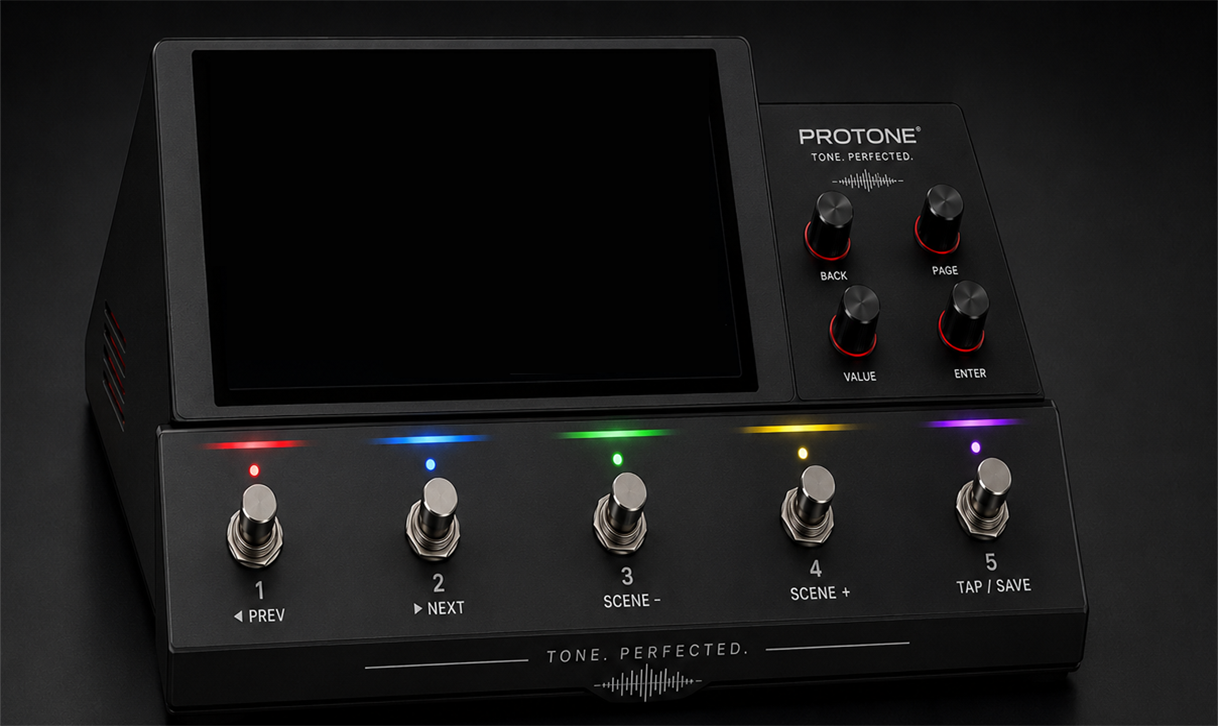
Because the Guitar Core resides inside the instrument, a dedicated external ProTone controller is not required.
Optional interfaces can nevertheless be incorporated where they provide additional value, including supported:
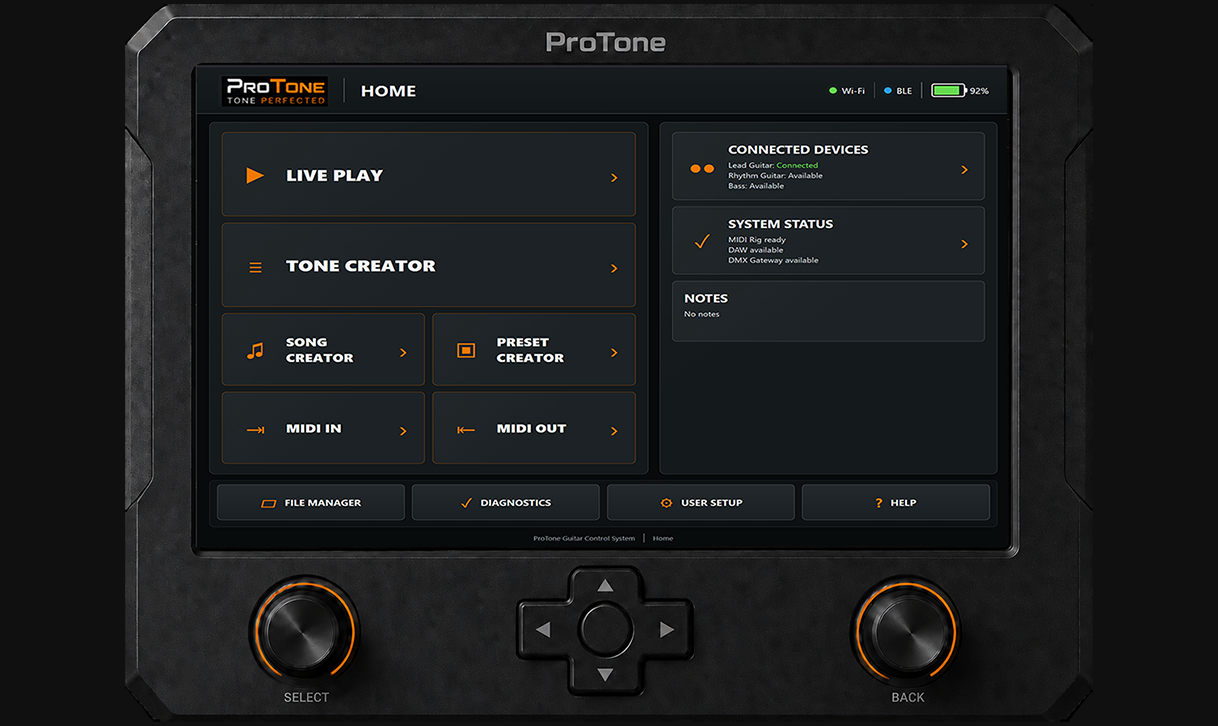
● dedicated touchscreen displays;
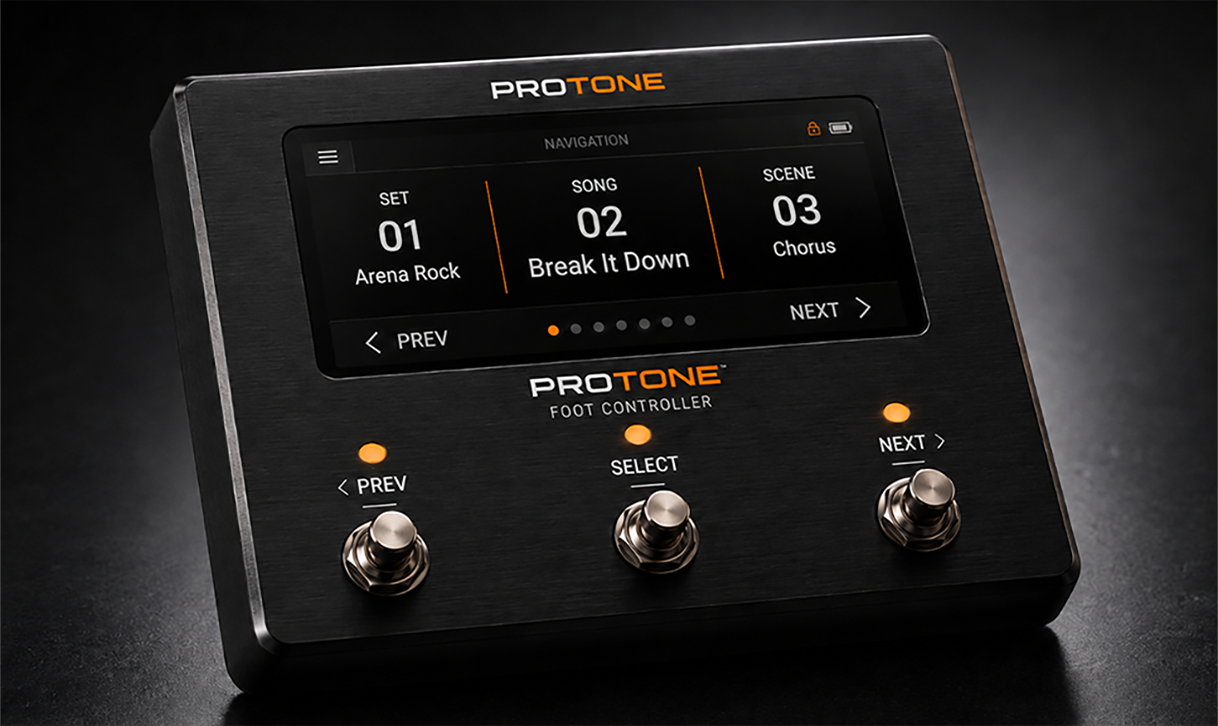
● performance controllers;
● basic foot-control systems no display;
● advanced foot-control systems with display;
● MIDI connectivity accessories; and
● other ProTone interfaces.
This gives partners flexibility in creating complete product packages without making an external controller mandatory to the underlying architecture.
Custom Branding & User Experience
Supported partner implementations can include customized:
● logos;
● product branding;
● interface presentation;
● product naming;
● startup presentation;
● Presets and profiles;
● documentation; and
● other partner-specific presentation elements.
This allows ProTone technology to operate within the partner’s existing brand and product environment rather than requiring every implementation to appear as the same retail product.
OEM & Licensed Integration
ProTone Stage V4 can support partner-specific engineering and integration requirements, including:
● instrument adaptation;
● supported MIDI integration;
● Expansion Tone Card development;
● interface customization;
● branding;
● product configuration; and
● other OEM requirements.
The underlying ProTone technology remains a common platform while the implementation can be configured around the partner’s product and market.
The objective is not to force every partner into the same ProTone product.
It is to provide a common platform from which different partners can build differentiated products.