
ProTone®
Next Gen Tonal Platform
ProTone® Technical Overview
ProTone® vs Major Pick Manufactures
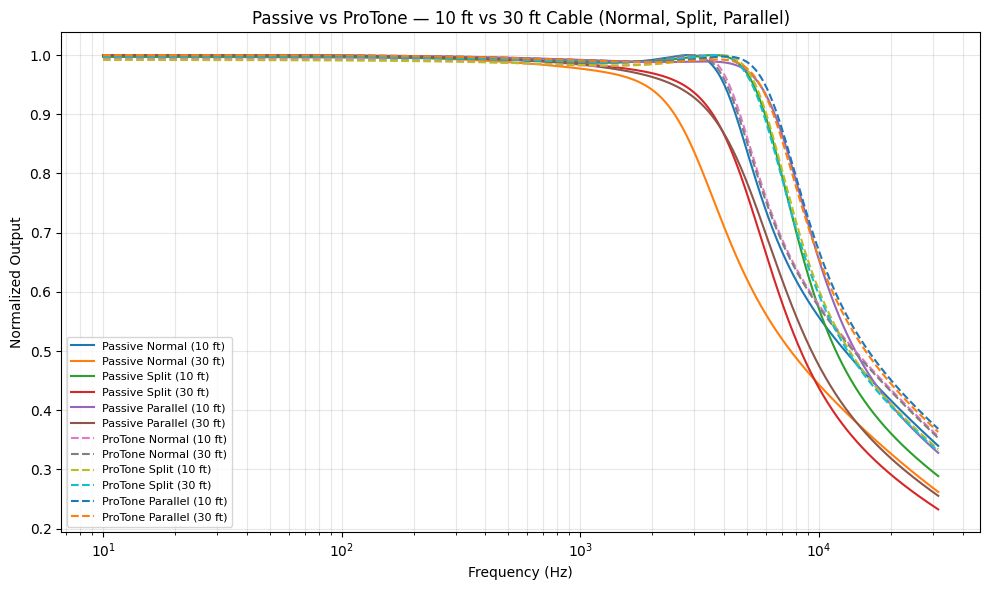
In a traditional guitar, changing cable length can noticeably affect your tone—especially in split and parallel modes. ProTone stabilizes the signal, so your tone stays consistent and your split and parallel sounds remain full and usable, no matter what you’re plugged into.
Passive System –
Major Pickup Manufacturers
- Tone shifts with cable length
- Split tones lose output and body
- Parallel tones become thinner
- Frequency response changes from rig to rig
- Large separation between 10 ft and 30 ft curves
- Resonant peak moves lower with longer cable
- High end rolls off sooner
- Split and parallel modes lose clarity and fullness
- Darker tone with longer cable
- Less consistency from one setup to another
- Split tones that sound weak or thin
- Parallel tones that can become overly lean
What Changes
What the Graph Shows
What the Player Hears
ProTone® System -
Using Same Pickups
- Cable length has minimal effect
- Split tones stay full and usable
- Parallel tones retain clarity and body
- Frequency response remains stable across setups
- 10 ft and 30 ft curves remain closely aligned
- Resonant peak stays in place
- High end remains intact
- Split and parallel modes keep their intended shape
- Consistent tone regardless of cable length
- Stable presets across rigs
- Split tones that remain strong and musical
- Parallel tones that stay clear without sounding weak
What Changes
What the Graph Shows
What the Player Hears
ProTone® Primary Takeaway
-
Passive Tone = Moving Target
ProTone Tone = Controlled System
The graph demonstrates that traditional passive wiring is influenced by cable capacitance and external loading, while ProTone stabilizes the signal at the source, so each tone remains predictable and repeatable.
- Coil turns
- Core material
- Geometry
- Buffers each coil (high input impedance, low output impedance)
- Blends signals post-buffer
- Each coil behaves independently
- The “combined inductance” is no longer a simple electrical sum
- More stable apparent inductance
- Less position-dependent behavior
- No reliance on passive coil-interaction math
- Passive system: Resonant frequency = function of L (inductance) + C (cable + tone cap) + load
- In ProTone:
- Buffers isolate the pickup from cable capacitance
- Loading is controlled and consistent
- Coil blending alters amplitude contribution, not raw inductance
- Predictable, consistent resonant peak
- No drastic shifts from:
- Cable changes
- Pot tolerances
- Parallel coil loading
- Series → inductance roughly sums → darker tone
- Parallel → inductance drops → brighter tone
- Coils are not electrically summed in the traditional sense
- They are voltage-blended after buffering
- Tonal changes similar to series/parallel
- Without actually changing inductance in the circuit
- Pickup inductance is heavily loaded by:
- 250k / 500k pots
- Cable capacitance
- Presents a very high impedance load to the pickup
- Drives output with low impedance
- Pickup inductance behaves closer to its natural state
- Less damping of high-frequency resonance
- Consistency: Presets sound the same regardless of cable or amp input
- No inductance collapse: Parallel/coil-split tones don’t thin out dramatically
- Controlled voicing:
- Tone shaped via blending and controlled loading
- Not by uncontrolled inductance interactions
- Intrinsic inductance (L): unchanged
- Circuit-level behavior of L: fundamentally altered
- System effect: inductance is no longer the dominant variable controlling tone shifts
Technical Aspect of ProTone®
How ProTone® Differs From Passive Systems to Provide Multiple Voicings
1. The Pickup’s Inductance
A pickup’s inductance is a physical property determined by:
This value is fixed unless the pickup is physically altered. ProTone does not modify this.
2. What ProTone Actually Changes
A. Effective Inductance Seen at the Output
Because ProTone:
You are no longer dealing with traditional passive series/parallel inductance interactions. Instead:
Result:
B. Resonant Peak Behavior (The Real Impact)
Inductance matters because of resonance:
Result:
C. Coil Blending vs Traditional Coil Combining
In a normal humbucker:
In ProTone:
Result:
D. Load Decoupling (Critical Point)
Traditional guitar:
ProTone:
Result:
3. Practical Interpretation
What the player experiences:
4. Bottom Line